Insight
Why choose CEIA metal detectors for the pharmaceutical industry?
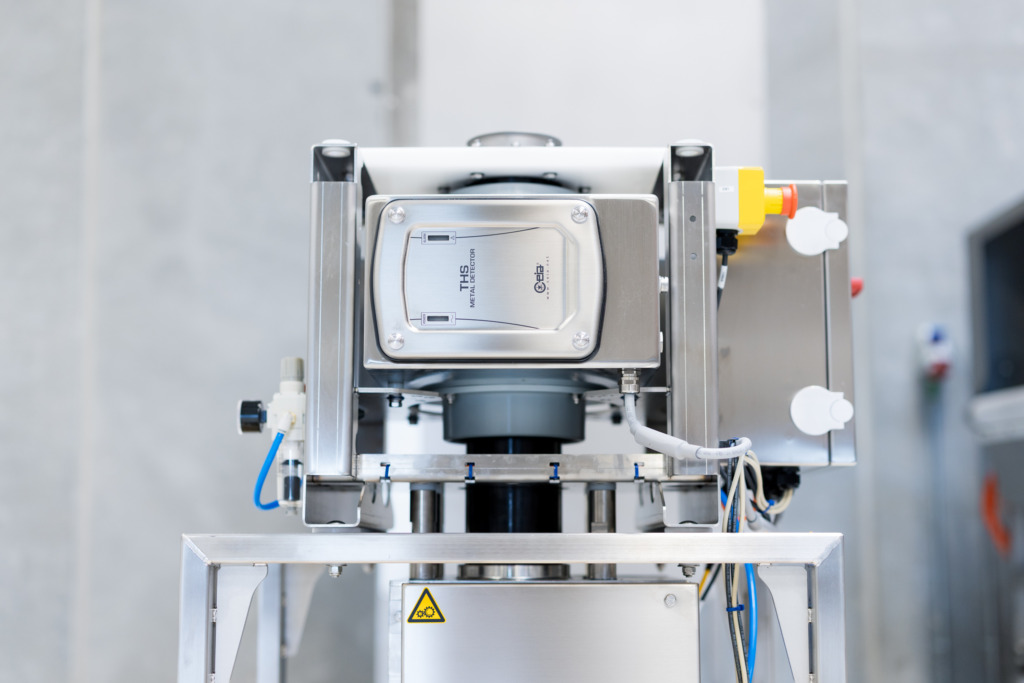
High detection sensitivity, reliable rejection and documentable quality control
In the pharmaceutical industry, product safety, quality and documentation are essential. Even tiny metallic foreign bodies in tablets, capsules or powder can pose a risk to patient safety and lead to scrapped products or production stoppages.
With CEIA’s Pharma metal detectors, metallic foreign bodies can be identified and rejected automatically, directly in the production process. The systems are designed with a focus on high detection sensitivity, hygienic design, reliable rejection and traceable documentation.
At Multicheck, we help you find and configure the right CEIA metal detector for your pharmaceutical production. We start from the product, the production capacity and the specific requirements for quality control, integration and validation.
Read more about CEIA’s metal detectors here
What are the benefits of CEIA metal detectors for pharma?
CEIA has developed the THS/PH21 and THS/PH210 series specifically for pharmaceutical and nutraceutical applications.
The systems combine advanced metal detection with functions that support a stable and documentable inspection process.
High sensitivity to metallic foreign bodies
CEIA’s Pharma metal detectors are designed to identify both ferrous and non-ferrous metals as well as stainless steel – even in small quantities.
The actual detection sensitivity depends on the product, the type of metal, the size of the foreign body and the chosen system configuration.
Automatic rejection with verification of the result
When the metal detector registers a metallic foreign body, the contaminated product can be rejected automatically.
CEIA’s Pharma systems also use sensors to verify that the rejection has actually taken place.
This is particularly important in pharmaceutical production, where it is not just a matter of identifying metal, but also of ensuring that contaminated products do not continue down the production line.
Stable detection with AUTO-LEARN and AUTOTEST
CEIA’s Multi-Point AUTO-LEARN helps optimise the detection settings for different products. The system analyses the product’s own signal so that the sensitivity can be adapted to the specific application.
At the same time, AUTOTEST continuously monitors the metal detector’s operation using internal reference signals.
This contributes to consistent detection performance and makes it easier to maintain a stable inspection process over time.
AUTO-QC – automated testing and documentation
With AUTO-QC, CEIA can automate parts of the periodic testing of the metal detector’s operation.
The system generates test signals corresponding to previously recorded manual test samples and checks, among other things, activation of the alarm and the reject device.
The results can be recorded as part of the quality documentation.
This can reduce the need for repeated manual tests, while the testing can still be adapted to the company’s own quality procedures.
However, AUTO-QC does not automatically replace all physical test procedures.
Metal detection of tablets, capsules, powders and liquids
CEIA offers a range of Pharma metal detectors, so the technology can be used at several stages of pharmaceutical production.
Tablets and capsules
CEIA’s THS/PH21 series is designed for inspecting tablets and capsules that pass through the detector by gravity.
The systems can be integrated directly with tablet presses, capsule filling machines and tablet dedusters, among others.
This makes it possible to identify and reject metallic foreign bodies as an integral part of the production process.
Powders and granulates
For powdered and granulated products, CEIA offers the THS/PH21N-FFV.
The system combines high detection sensitivity with fast rejection of contaminated material and is designed to maintain an efficient product flow.
An ATEX Zone 21 version is also available for relevant applications.
Liquid and viscous products
For products conveyed through pipelines, CEIA offers the THS/PLV21.
The system can be integrated directly into the plant’s pipework and used to detect metallic foreign bodies in liquid and viscous products.
The THS/PLV21 is designed with a focus on hygienic construction and suitability for CIP cleaning.
CEIA THS/PH21N and THS/PH21ET – high sensitivity for pharma
CEIA offers a variety of models for pharmaceutical metal detection.
THS/PH21N – ultra-high detection sensitivity
The THS/PH21N is designed for applications with stringent requirements for detection sensitivity and documentation.
The system uses digital signal processing and can store up to 500 product profiles, making it possible to use different settings for different products.
This is an advantage in production environments where several types of tablets or capsules are manufactured on the same line.
THS/PH21ET – compact and flexible metal detection
The THS/PH21ET is a compact Pharma metal detector with high sensitivity to magnetic and non-magnetic metals as well as stainless steel.
The model supports up to 250 product profiles and features AUTOTEST and AUTO-QC, among other functions.
The choice between the models depends on the specific application and the requirements for sensitivity, production capacity and documentation.
Hygienic design and solutions for demanding production environments
In pharmaceutical production, cleaning and the prevention of cross-contamination are important elements of quality control.
CEIA’s Pharma metal detectors are designed with a focus on hygienic design and use materials such as AISI 316L stainless steel.
On relevant models, product-contact components are designed for quick, tool-free disassembly, making cleaning and maintenance easier.
For special production requirements, CEIA also offers specialised solutions.
Dust Tight – limits the spread of product dust
The CEIA THS/PH21N-DT is designed for production where product dust must be contained.
The system has a fully sealed product passage and reject unit with OEB 5-certified containment.
This makes the solution relevant for pharmaceutical processes with special requirements for handling product dust and preventing exposure.
Wash In Place – cleaning between production batches
The CEIA THS/PH21N-WIP has an integrated Wash In Place system that allows the product channels to be cleaned at the end of a production batch.
The system has built-in nozzles for supplying wash water and is designed with a sealed product passage and reject unit.
This can be an advantage in production with stringent requirements for cleaning and containment.
Specialised metal detection for effervescent tablets and R&D
CEIA also offers solutions for more specific pharmaceutical applications.
The THS/PH21N-FB for effervescent tablets is designed to detect small metal fragments in effervescent tablets and combines high sensitivity with automatic rejection and verification of the rejection process.
The THS/PH21N-D25 for R&D and analysis can be used for product development, inspection of rework and investigations into the causes of metal contamination, among other things.
This makes it possible to use metal detection both in regular production and in the company’s quality and development work.
Documentation, traceability and FDA 21 CFR Part 11
In the pharmaceutical industry, it is not enough for quality control to work. It must also be documented.
CEIA’s THS/PH21 and THS/PH210 systems are designed with functions that support relevant requirements for data security, data integrity and traceability.
Depending on model and configuration, the systems can record, among other things:
- Metal detections and rejections
- Changes to product settings
- User actions and access
- Calibration and inspection tests
- AUTO-QC results
CEIA also offers user management with access rights and functions for protecting recorded data.
The systems are designed with functionality to support FDA 21 CFR Part 11, including electronic records and traceability.
However, overall regulatory compliance also depends on the company’s own procedures, system set-up and validation.
THS Production 4.0 – a complete overview of quality control
With CEIA THS Production 4.0, data from connected metal detectors can be collected and managed centrally.
The software makes it possible to collect operating and inspection events, manage data and generate reports for statistics, traceability and quality documentation, among other purposes.
This makes it easier to follow up on events and work systematically with documentation across production lines.
Together with the metal detectors’ data logging and automatic testing functions, THS Production 4.0 can support a more digital and documentable quality process.
CEIA metal detectors as part of GMP and validation
In pharmaceutical production, inspection equipment must form part of the company’s overall quality system.
CEIA offers calibration standards, validation documentation and tools for testing and documenting the performance of the metal detectors, among other things.
This can support work with GMP and equipment qualification.
During implementation, the requirements for IQ, OQ and PQ, inspection procedures, user rights and data handling, for example, must be defined based on the company’s specific application and quality system.
At Multicheck, we help clarify the technical requirements and options in connection with the selection, installation and integration of the metal detector.
Which CEIA Pharma metal detector should you choose?
The right metal detector depends on the product, the production process and the requirements placed on quality control.
Among other things, it is important to assess:
- Product type: Tablets, capsules, powder, granulate or liquid
- Detection requirements: Which metals and sizes need to be identified
- Production capacity: Speed and material flow
- Rejection: How contaminated products are to be removed and verified
- Hygiene: Requirements for cleaning, Dust Tight or Wash In Place
- Documentation: GMP, traceability, data integrity and validation
- Integration: Interaction with existing production equipment and data collection
At Multicheck, we help assess the specific application and find the CEIA solution that meets your production and quality requirements.
Why choose CEIA Pharma metal detectors through Multicheck?
An effective metal detector must do more than deliver high sensitivity. It must also integrate into the production line, ensure correct rejection and support the company’s documentation requirements.
At Multicheck, we help throughout the entire process – from initial advice to installation, commissioning and ongoing service.
We advise on the choice of metal detector, product set-up, integration, inspection functions and relevant documentation options.
We can also help clarify the options for testing with your own products, so the required detection sensitivity can be assessed under relevant conditions.
Service never sleeps – 24/7/365
When metal detection is a critical control point in pharmaceutical production, downtime can have consequences for the entire production line.
That is why Multicheck offers service and technical support 24 hours a day, 365 days a year.
We help with installation, commissioning, troubleshooting, preventive maintenance and repairs.
Depending on the task, our technicians can help via remote support or carry out service on site at the customer’s premises.
Would you like to know which CEIA metal detector is best suited to your pharmaceutical production?
Related articles

Do you need help?
If you would like to hear more about our solutions, please fill out the form and we will contact you as soon as possible.
If you need urgent assistance, you can contact us 24/7/365 on +45 75 60 22 22.