Insight
Why choose a CEIA metal detector for the food industry?
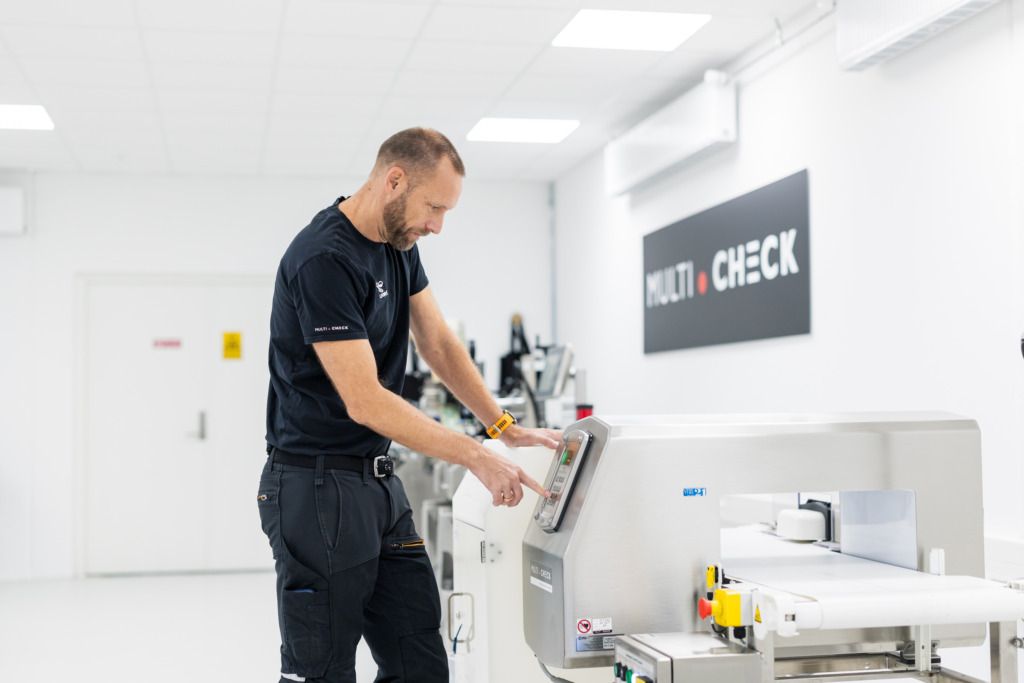
When food safety and precision are critical
A single metallic foreign body can have major consequences in food production. It can lead to scrapped products, production stoppages, complaints and, in the worst case, recalls that affect both consumer safety and the company’s reputation.
That is why metal detection is about far more than simply finding metal. It is about ensuring stable production, minimising the risk of contamination and documenting that quality control works.
With CEIA’s industrial metal detectors, you get advanced technology designed to identify ferrous metals, non-ferrous metals and stainless steel – even in foods where the product’s own properties make detection difficult.
At Multicheck, we help you find the right CEIA metal detector, giving you a solution that suits your products, production line and food safety requirements.
Find CEIA’s metal detectors here
When the food makes metal detection difficult
Not all foods are equally easy to inspect.
Moist, salty or electrically conductive products can create their own signal in a metal detector. This is known as product effect and can make it harder to distinguish between the food itself and a metallic foreign body.
This is a relevant challenge, for example, when inspecting meat, fish, dairy products and other foods with a high moisture or salt content.
Here it is crucial to choose a metal detector that can handle the product signal without unnecessarily compromising detection sensitivity.
CEIA has therefore developed Multi-Spectrum Technology, which analyses the differences between the frequency response of the product and that of metallic foreign bodies.
The technology makes it possible to compensate for product effect while maintaining high sensitivity to different types of metal – including stainless steel, which is often more difficult to detect than ferrous metal.
This provides a better basis for reliable metal detection, even when products are difficult to inspect.
High detection sensitivity – with fewer unnecessary interruptions
An effective metal detector must not only be sensitive. It must also be able to distinguish between genuine metal finds and variations in the product.
Otherwise, the company risks unnecessary rejections, product waste and interruptions to production.
With CEIA’s AUTO-LEARN, the metal detector can automatically analyse the product signal and optimise the detection parameters. CEIA describes this process as an optimisation equivalent to hundreds of conventional product passes.
In the THS 21 series, advanced AUTO-LEARN can also collect information about variations in the product signal in the background while production continues. This information can then be used to optimise the detection parameters.
This is particularly relevant in production where product properties vary or where there are frequent changeovers between different products.
The benefit is a metal detector that can be adapted to the specific food and production process, so high detection sensitivity can be combined with more stable operation.
Automatic rejection – so contaminated products do not continue in production
When the metal detector registers a metallic foreign body, it is crucial that the contaminated product is handled correctly.
CEIA offers integrated solutions with automatic rejection, where the product is removed from the normal product flow.
Depending on the product and the production line, rejection can take place using, for example, an air blast, a mechanical pusher, a belt stop or a retracting conveyor.
In relevant system configurations, sensors can also check whether the rejection has been carried out correctly and monitor the presence and capacity of the reject bin.
This provides an extra check on the process and helps detect errors in the handling of contaminated products.
At the same time, the metal detector can be integrated with the rest of the production line, so detection, product transport and rejection work together.
Documented quality control with AUTO-QC
In the food industry, it is not enough for a metal detector to work correctly. The company must also be able to check and document that the system continues to meet the defined requirements.
CEIA therefore offers functions such as AUTOTEST and AUTO-QC, which support monitoring and verification of the metal detector’s operation.
With AUTO-QC, periodic checks can be automated using previously recorded test signals. The system can check the detection function and, where relevant, the rejection.
This can reduce the need for manual test procedures and save operator time, while giving the company a better basis for documenting its quality control.
CEIA’s THS 21 systems also offer functions for recording events, detections and test results, so relevant information can be used in the company’s quality assurance and traceability work.
The specific documentation functions depend on the model and configuration.
From packaged foods to powders and liquid products
One of the advantages of CEIA is its wide range of metal detectors for different types of food production.
Whether products are conveyed on a belt, fall through a pipe or are pumped through a closed production line, CEIA offers solutions tailored to the specific application.
Packaged foods and products on conveyor belts
CEIA’s THS 21 series can be integrated with various conveyor and reject systems for automatic inspection of products in motion.
This could be, for example, pre-packed foods, trays, bags and cartons, where the products must be inspected before they continue in production.
Powders, granulates and free-falling products
For products that move through the production plant in free fall, CEIA offers the THS/G21 and THS/FFV21 systems, among others.
The solutions are designed to identify metallic foreign bodies in the product flow and can be configured with automatic rejection of the contaminated portion.
Liquid and viscous foods
For products pumped through pipelines, CEIA offers the THS/PL21 and THS/PLV21, among others.
The THS/PLV21 has an integrated reject valve, so metal-contaminated quantities of product can be removed from the product flow.
The systems are designed with a focus on high detection sensitivity, hygienic construction and integration into food production.
The wide range means that metal detection can be adapted to the production process rather than the other way round.
Hygienic design for demanding food production
In many food production facilities, equipment must be able to withstand frequent and thorough cleaning.
CEIA therefore offers metal detectors constructed in AISI 316L stainless steel and solutions designed for demanding washdown environments.
Several models have an IP66 or IP69K rating depending on the version, while relevant pipeline systems are designed with product-contact components that can be included in CIP cleaning processes.
For particularly demanding cleaning environments, CEIA offers the THS/210-MBH9, among others, which is designed for food production with stringent hygiene requirements, for example in the meat, poultry and fish industries.
Here, advanced metal detection is combined with a construction suited to intensive cleaning.
This helps ensure that the metal detector suits not only the product but also the practical conditions in the production environment.
Why choose a CEIA metal detector?
The difference is not just whether the metal detector can find metal.
With CEIA, you get access to a combination of advanced detection technology, automatic product adaptation, flexible integration and functions for documented quality control.
Multi-Spectrum Technology provides a better basis for handling demanding product effect. AUTO-LEARN makes it possible to optimise the detection parameters for the product, while AUTO-QC can support more automated testing of the system’s operation.
At the same time, the solutions can be adapted to different products, conveying methods, rejection needs and cleaning environments.
For food companies, this means the opportunity to combine high detection sensitivity, fewer unnecessary rejections and more efficient quality control.
Multicheck helps you choose the right CEIA metal detector – and keeps it running
The best metal detector is not necessarily the one with the most features. It is the one that works optimally with your specific products and production line.
At Multicheck, we start from your production when advising on the choice of CEIA metal detector.
Among other things, we assess the product’s properties, product effect, packaging, production speed, detection sensitivity requirements and the need for automatic rejection.
We also help with integration, installation, commissioning and ongoing maintenance.
And our partnership does not end once the metal detector is installed.
With our 24/7/365 service, you have access to technical assistance around the clock, every day of the year. We offer both remote support and on-site service, so we can help find the right solution whenever you need assistance.
For us, it is not just about supplying a metal detector. It is about helping you maintain safe, stable and efficient production.
Would you like to know which CEIA metal detector is best suited to your food production?
Related articles
Do you need help?
If you would like to hear more about our solutions, please fill out the form and we will contact you as soon as possible.
If you need urgent assistance, you can contact us 24/7/365 on +45 75 60 22 22.