Insight
What is an electromagnetic force restoration load cell from Wipotec?
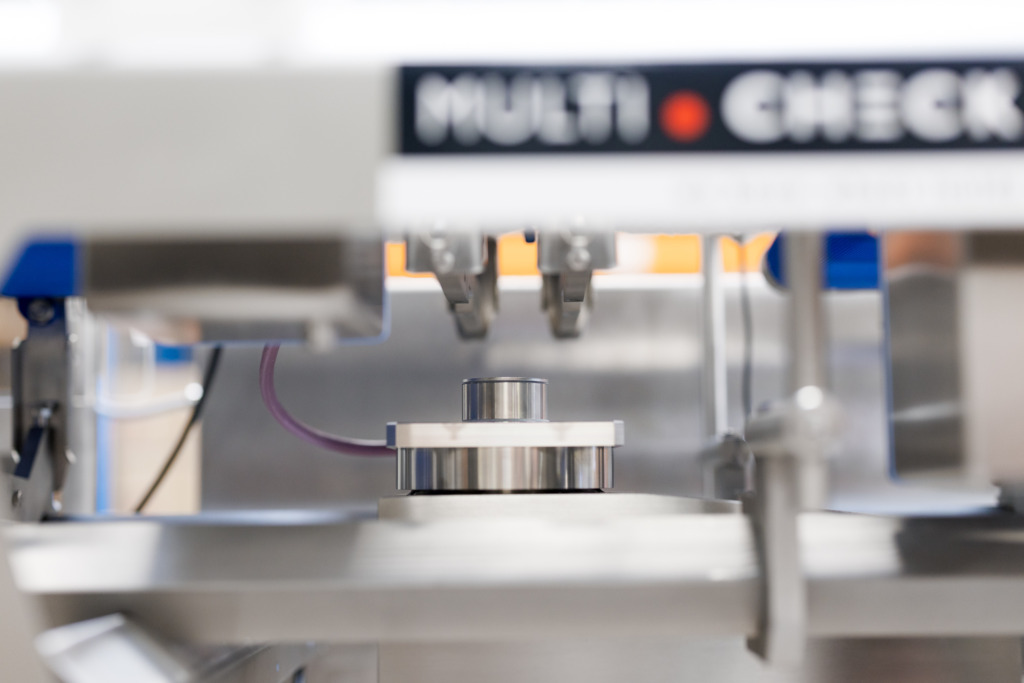
An electromagnetic force restoration load cell from Wipotec uses electromagnetic force compensation (EMFR weighing technology) to measure weight with high precision and fast registration. The technology is well suited to both static and dynamic weighing where accuracy, repeatability and stability are required.
But how does an electromagnetic force restoration load cell actually work, and what is the difference between EMFR and a traditional strain gauge load cell?
Here we take a look at the technology, its benefits and its industrial applications.
Read more about Wipotec’s checkweighers here
How does Wipotec’s EMFR weighing technology work?
EMFR stands for Electro-Magnetic Force Restoration and is the measuring principle Wipotec uses in its electromagnetic force restoration load cells.
Unlike traditional load cells, which measure a physical deformation, EMFR works with electromagnetic force compensation.
The principle works like this:
- The product is placed on the load cell, and the weight force acts on the mechanical balance system.
- An optical position sensor registers the movement when the system deviates from its point of balance.
- An electromagnetic counterforce is activated by sending current through a coil in a magnetic field.
- The system is kept in balance, and the compensation current required is used to calculate the weight.
This means that the weight is determined from the electromagnetic force required to counteract the load.
This technology enables high measurement resolution, short settling time and precise weight registration – even when products are moving through a production line.
EMFR vs. strain gauge – what is the difference?
Both EMFR and strain gauge are used for industrial weighing, but they measure weight in different ways.
A strain gauge load cell registers the minute deformation that occurs in an elastic element when it is loaded. The deformation changes the electrical resistance in the attached strain gauges, and the signal is converted into a weight value.
An electromagnetic force restoration load cell from Wipotec, on the other hand, uses electromagnetic force to counteract the load and keep the weighing system in balance.
| Property | Wipotec EMFR | Strain gauge |
|---|---|---|
| Measuring principle | Electromagnetic force compensation | Measurement of deformation |
| Precision | High resolution and repeatability | Depends on the load cell |
| Speed | Short settling time | Depends on the design |
| Dynamic weighing | Particularly suitable for high requirements | Also possible |
| Vibrations | Option for active compensation | Depends on the system |
| Application | Static and dynamic precision weighing | General industrial weighing |
In short: Strain gauge measures how much a material deforms. Wipotec EMFR measures the electromagnetic force needed to keep the weighing system in balance.
Both technologies can be relevant. The choice depends on the product, the weighing range and the requirements for precision, speed and integration.
What are the benefits of Wipotec’s electromagnetic force restoration load cells?
Wipotec’s EMFR weighing technology combines high precision with fast weight registration and flexible integration options.
High precision and short settling time
One of the most important advantages of EMFR is the combination of high measurement resolution, good repeatability and short settling time.
Settling time describes how quickly the load cell can achieve a sufficiently stable measurement after a change in load.
This is particularly important in dynamic weighing, where the product is only on the weighing section for a short time.
The actual precision and settling time depend on the load cell, the installation and the production conditions.
Fast weight registration – up to 1,000 measured values per second
Selected Wipotec EMFR load cells have a sampling rate of 1 millisecond, corresponding to up to 1,000 measured values per second.
This enables rapid registration of weight changes and supports dynamic weighing at high production speeds.
However, sampling rate and settling time are not the same thing. A sampling rate of 1 ms does not mean that the load cell necessarily delivers a fully settled weight value after 1 ms.
Stable weighing with active vibration compensation
Vibrations from conveyor belts, motors and other production equipment can affect the weighing result.
For selected load cells, Wipotec offers AVC (Active Vibration Compensation), which registers and compensates for external vibration influences.
This can improve stability in production environments where vibrations could otherwise affect the measurement results.
Easy integration into automated production lines
Wipotec’s electromagnetic force restoration load cells are designed for integration into industrial machines and production plants.
Depending on the model and interface configuration, Wipotec offers communication options such as CANopen, EtherCAT, EtherNet/IP and PROFINET IO.
This makes it possible to use weight data directly in the machine control system and automate processes where precise weight registration is crucial.
What are Wipotec EMFR load cells used for?
Electromagnetic force restoration load cells are used in many different industrial weighing processes – both when the product is stationary and when weighing takes place in motion.
Typical areas of application include:
- Static weighing: Precise weight determination of products and materials.
- Dynamic weighing: Fast weight control of products in motion.
- Checkweighing: Checking product weight in automated production lines.
- Dosing and filling: Precise weight registration during dosing and filling processes.
- Machine integration: Integration of load cells into special-purpose machines, multi-lane systems and automated plants.
Wipotec’s EMFR technology is therefore relevant for both general industrial weighing tasks and more demanding applications with high requirements for speed and precision.
When should you choose EMFR over strain gauge?
An electromagnetic force restoration load cell is particularly interesting when production requires a combination of high measurement resolution, short settling time and reliable weight registration.
This applies, for example, to fast dynamic checkweighing, precise dosing processes and machines where there is only a short time to register the product’s weight.
Strain gauge remains a well-proven technology that works well in many industrial applications.
The choice should therefore not be based solely on the measuring principle, but on the specific task, the weighing range, the production speed, the installation conditions and the overall cost.
Find the right Wipotec load cell at Multicheck
At Multicheck, we help you find the Wipotec electromagnetic force restoration load cell that suits your production.
We start from the weighing range, the requirements for precision and speed, and the mechanical and electronic integration.
Whether you need a load cell for static weighing, dynamic checkweighing, dosing or integration into a special-purpose machine, we advise on the right solution.
We also help with installation, commissioning and technical support. With our 24/7/365 service, we are also ready to help when you need assistance after installation.
Would you like to know more about Wipotec’s EMFR load cells?
Related articles
Do you need help?
If you would like to hear more about our solutions, please fill out the form and we will contact you as soon as possible.
If you need urgent assistance, you can contact us 24/7/365 on +45 75 60 22 22.