Insight
Linx laser marking – permanent marking with high precision
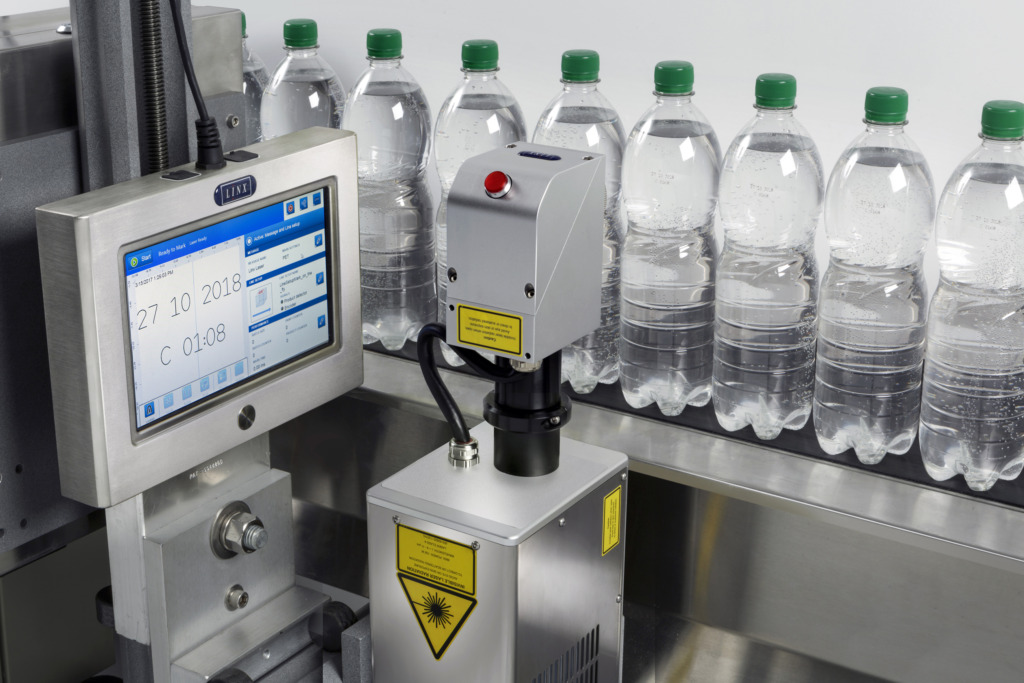
With Linx laser marking, you get a reliable and flexible solution for permanent marking of products and packaging – with no ink, solvent or other consumables needed for the marking itself.
Whether you need to mark plastic, glass, metal, film or cardboard, Linx offers different laser technologies that can be adapted to the material, the production speed and the marking requirements.
Linx laser printers can be used for everything from date marking, batch numbers and serial numbers to logos, barcodes and 2D codes such as QR and Data Matrix. Marking takes place directly on the product or packaging and can be integrated into both new and existing production lines.
At Multicheck, we help you find the right Linx laser for your production. We advise on the choice of laser technology, test the marking on your own products and ensure that the solution suits both the material and the production process.
Why choose laser marking from Linx?
Laser marking is an effective solution for companies that want permanent product marking, high operational reliability and lower running costs.
Unlike traditional ink-based marking systems, lasers do not use ink or solvent to create the code. This means fewer consumables, less handling and more predictable operation.
Linx lasers offer benefits including:
- Permanent marking: Durable codes directly on the product or packaging, with no risk of ink smudging.
- No ink or solvent: Reduced consumption of marking materials and lower running costs.
- High production speed: Marking on fast production lines without compromising code legibility.
- Precise and flexible marking: Dates, batch numbers, serial numbers, logos and machine-readable codes.
- Low maintenance requirement: Long laser source life and fewer ongoing interventions.
- Easy integration: Flexible marking heads and configurations for both new and existing production lines.
The actual marking quality and speed depend on the material, the laser power and the chosen configuration.
CO2, fibre or UV – which Linx laser should you choose?
Linx offers three different laser technologies, each with particular strengths depending on the material and the desired marking.
Linx CO2 lasers – flexible marking of packaging
CO2 lasers are well suited to marking a wide range of packaging materials, including cardboard, paper, glass, PET and selected plastics.
Linx offers models including the CSL10, CSL30 and CSL60, which are designed for different requirements in terms of marking speed, materials and production capacity.
The CSL10 and CSL30 deliver 10 W and 30 W respectively, while the more powerful 60 W CSL60 is designed for demanding materials and fast production lines.
The CSL60 also features VisiCode technology, which is designed to create clear marking on glass – even at high production speeds.
With multiple options for marking heads, lenses and mounting orientations, Linx CO2 lasers can be adapted to different packaging formats and production lines.
The benefit for you: A flexible and permanent marking solution that can handle both simple date codes and more complex product information.
Linx fibre lasers – precise marking on metal and plastic
For marking metal, plastic and packaging film, among other materials, Linx offers the FSL20 and FSL50.
The fibre lasers deliver 20 W and 50 W respectively and are designed for permanent marking with high precision.
The fine laser beam makes it possible to create clear codes and detailed information on even small marking areas. This is relevant, for example, for serial numbers, Data Matrix codes, logos and traceability marking.
Linx fibre lasers have an expected laser source life of more than 100,000 hours and use air cooling, which contributes to a low maintenance requirement.
Their compact design also makes them well suited to integration into automated production lines and special-purpose machines.
The benefit for you: Precise and permanent marking with a long service life and low maintenance requirements.
Linx UV laser – gentle marking of sensitive materials
Some materials are difficult to mark with traditional laser technologies because they are sensitive to heat or require very fine and clear codes.
For these, Linx offers the UVG5, which uses UV laser technology for precise marking with low thermal impact.
This makes the UVG5 particularly relevant for sensitive plastics, thin films and mono-material packaging, among others, where you want to reduce the risk of heat damage.
The UVG5 can mark at up to 2,000 characters per second, depending on the application, and supports both plain text and machine-readable codes such as Data Matrix, QR and GS1 codes.
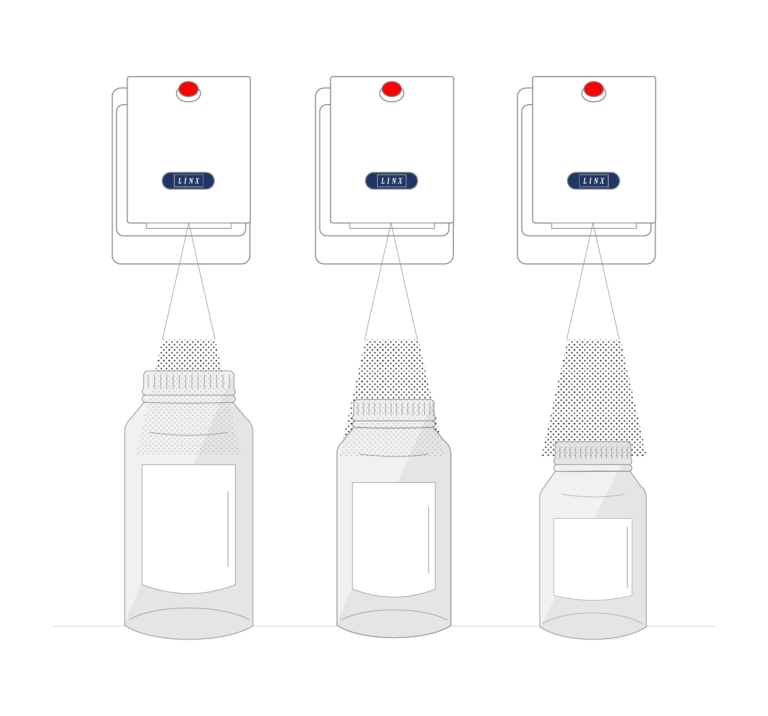
The system also has built-in Focus Shift, so products of different heights can be marked on the same production line without mechanically moving the laser.
With Pilot Laser and Focus Finder, it is also easier to position the marking correctly and set the right marking distance.
The benefit for you: Gentle and precise marking on materials where conventional laser marking can be difficult.
Which products and materials can be marked with Linx lasers?
Linx laser marking is used in many different industries where products and packaging need to carry clear, durable and traceable information.
Examples include:
- Food and beverages: Date marking, batch numbers and traceability on bottles, cartons and other packaging.
- Pharma and cosmetics: Precise marking of packaging with batch numbers, serial numbers and 2D codes.
- Industry and electronics: Permanent marking of components, plastic parts and metal products.
- The packaging industry: Marking of cardboard, plastic film, PET and other packaging materials.
The choice of laser depends not only on the material, but also on the colour, surface and thickness of the packaging and the requirements for marking contrast and legibility.
That is why we at Multicheck always recommend testing the marking on the actual product before the final solution is chosen.
Easy operation and integration into production
Linx lasers are designed to function as an integrated part of the production line.
With LinxVision and LinxDraw, depending on the laser model, the operator can create and manage marking jobs with dates, variable information, serial numbers and barcodes, among other things.
The systems offer various options for user access and access restriction, which can help reduce errors when creating and changing marking jobs.
At the same time, flexible marking heads, different lenses and beam direction options provide a good basis for integration – even where space around the production line is limited.
Linx also offers the option of marking across multiple product lanes and larger marking areas, depending on the model and configuration.
What does it cost to use laser marking?
When assessing an investment in a laser printer, it is important to look at more than just the purchase price.
Since laser marking does not require ink or solvent, the ongoing costs of consumables can be significantly reduced.
At the same time, the long life of the laser sources and the limited maintenance requirement can contribute to an attractive Total Cost of Ownership (TCO).
However, the total costs depend on the laser technology, production environment, operating time, energy consumption and the need for extraction and safety guarding, for example.
At Multicheck, we are happy to help assess the total running costs and compare laser marking with your current marking solution.
Find the right Linx laser at Multicheck
The best laser is not necessarily the one with the highest power. It is the one that creates the right marking on your material – with the desired speed, legibility and operational reliability.
At Multicheck, we help with the entire process, from choosing the technology to installation and ongoing operation.
We advise on CO2, fibre and UV lasers, assess the integration options and offer marking tests on your own products, so you can see the result before you decide.
We also help clarify the need for safety guarding and extraction, which are important parts of a complete laser installation.
Service never sleeps – 24/7/365
When marking is a critical part of the production line, downtime can quickly have consequences.
That is why Multicheck offers 24/7/365 service and technical support, as well as help with installation, commissioning, maintenance and repair.
Would you like to find out whether laser marking can optimise your production and reduce your ongoing marking costs?
Related articles
Do you need help?
If you would like to hear more about our solutions, please fill out the form and we will contact you as soon as possible.
If you need urgent assistance, you can contact us 24/7/365 on +45 75 60 22 22.